
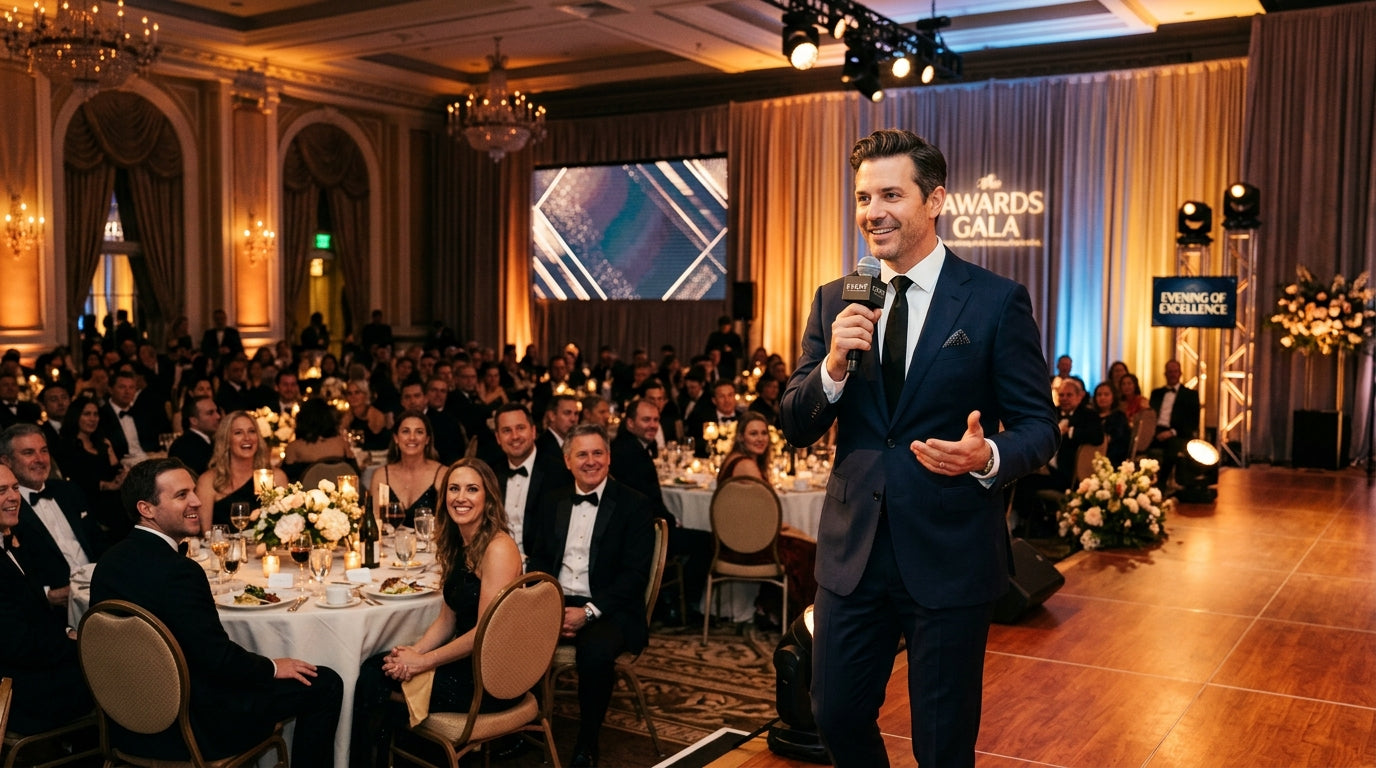
The Night the Emcee Saved the Event
I got a call once from an event planner three days before a major awards show. Their original host had cancelled. The event had 400 attendees, a live band, six award categories, two video tributes, and a program that had to wrap by 9:30 PM sharp because the venue had a hard out.
I took the gig. And I'll be honest: it was one of my favorite nights.
Not because everything went perfectly. The teleprompter failed 20 minutes in. One award winner didn't show up. And the video tribute for the keynote honoree ran 90 seconds longer than it was supposed to.
But the audience never knew. Because that's the job. A professional emcee for corporate events isn't just a person with a microphone reading names off a list. We are the connective tissue of the entire evening. We hold the energy, manage the transitions, adapt on the fly, and make sure the audience always feels like they're exactly where they're supposed to be.
Here's what that actually requires.
It's Not About Being Funny
People assume a great emcee is just someone who's good at comedy. Warm crowd up. Tell some jokes. Keep it moving.
That's a fraction of the job.
The real skill is reading the room. Every audience has a rhythm. A fundraiser for a nonprofit has a completely different energy than a franchise awards convention. A company's internal all-hands feels nothing like an industry association conference. A great emcee doesn't bring one fixed energy to every room. They bring the right energy for that specific room, on that specific night.
I've emceed events across the full range: awards shows, fundraisers, corporate town halls, franchise conventions, association conferences. Each one taught me something. And the thing I've learned most consistently is that the audience follows the host. If you are confident, they relax. If you are warm, they open up. If you treat every person who walks to that stage with genuine respect and attention, the whole event elevates.
That's not performance. It's craft.
What I Actually Do Before the Event Starts
Here's something most people don't think about: a professional emcee's work starts long before they touch the microphone.
I have a detailed pre-event process. I review the full run of show with the event organizer. I learn how to correctly pronounce every name. I understand what each award means and why it matters to that organization. I know which speakers need more time and which segments need to move fast. I know the venue's cues, the AV team's signals, and the hard stops.
Because on the night of the event, I'm not managing a script. I'm managing the experience.
When something goes sideways, and something always does, I know the plan well enough to improvise without the audience ever seeing the seams. That's only possible because of the work done in advance.
If you're planning an event and want to understand what the pre-event collaboration looks like, take a look at how I work with organizers. The preparation process is a big part of why events go smoothly.
What to Look for When Hiring a Corporate Emcee
If you're in the market for a professional emcee, here are the things I'd focus on:
Watch them on video. Not a highlight reel. Real footage from a real event. You want to see how they handle transitions, how they treat presenters and honorees, and what happens when something unexpected comes up.
Ask about their prep process. A great emcee will ask you a lot of questions before they agree to anything. They should want to know the audience, the tone, the goal of the event, and the moments that matter most to leadership.
Check for range. Some emcees are great at high-energy fun but fall flat on the heartfelt moments. Others are warm and sincere but can't drive energy when you need it. You want both. The best events move through different emotional registers, and your host has to move with them.
The International Live Events Association has great resources on what professional event hosting standards look like. It's worth understanding what best-in-class actually means before you book.
The Emcee's Real Job During an Awards Show
Let me get specific about awards shows, because they have their own dynamics.
The biggest challenge at an awards show isn't the winners. It's the pacing. These events can drag badly if the host doesn't actively manage the energy between every single segment. And they can feel rushed and cold if the host doesn't give each winner a genuine moment.
I think about it in three layers.
First: honoring the moment. Every person who walks to that stage has earned it. My job is to make sure they feel that, and that the audience feels it too.
Second: keeping the program moving. Gracefully. Without making anyone feel rushed. That's a real skill.
Third: holding the room's energy. The natural dip that happens around the 90-minute mark at any event? That's when a great emcee earns their fee. Knowing how to re-engage the audience at that moment, without gimmicks, is something that comes from experience.
I've hosted enough of these to know exactly where the danger zones are. And I plan for them in advance.
One Thing Most Emcees Miss
Authenticity.
Audiences today are sharp. They know when someone is performing warmth versus actually feeling it. They can tell when the host cares about the organization versus just cashing a check.
Every event I host, I spend time genuinely understanding what the organization is celebrating and why it matters. I want to feel it before I can help the audience feel it. That's not a technique. It's just how I approach the work.
You can read more about the kinds of events I host and see what clients have said about the experience.
Let's Make Your Event Memorable
If you're organizing a corporate awards show, a fundraiser, a conference, or a company event and you need a professional emcee who will treat the job with the seriousness and energy it deserves, let's talk.
I bring the same commitment to hosting that I bring to every keynote: full preparation, genuine connection with the audience, and the adaptability to keep the night on track no matter what. Reach out through my website and let's start planning.